Showing posts with label childhood. Show all posts

Wednesday, July 28, 2010

What Do You Want to Be When You Grow Up?


It's the age-old question presented on a pretty regular basis to anyone under the age of 13. What do you want to be when you grow up? It's quite possibly the first real thought-provoking moment of a kid's life when he or she gives the question an honest answer. What do you want to be when you grow up? Ironically, in many ways the answer to the question does more to define the person you are at that instant than it does to define the person you will ultimately become. What do you want to be when you grow up? The answers to that question often define a generation. What do you want to be when you grow up? In post-WWII America the popular answer has gone from firefighter or policeman, to astronaut or President, to actor or ballplayer, to rock star or comedian. What do you want to be when you grow up? You find the answers to this question often without even asking it; all you need to do is look at the posters that line a kid's bedroom walls. What do you want to be when you grow up? In the '50s and '60s it was Mickey Mantle, JFK, and Jim Morrison. In the '70s and '80s it was Mick Jagger, Joe Montana, and Farrah Fawcett. In the '90s and '00s we had Michael Jordan, Britney Spears, and Mike Myers. But I wonder, who's tacked up on the bedroom walls of young people today? What do they want to be when they grow up?

Before I get too deep and/or nostalgic here, allow me to tell you what my point is. Look at the handful of names I threw out off the top of my head in the previous paragraph. All of those people were, at one point or another, at the top of the line in their professions. Not all of them were saints; in fact, many of them either had some questionable habits or found themselves immersed in some sort of controversy. But at the very least, they earned their keep. They did their jobs and did them extremely well. Compare that to today - how many people do we see being richly compensated for what frankly amounts to a job poorly done? And (this is slightly tongue-in-cheek), is it close to reaching the point where making a fortune for either doing nothing, or merely doing nothing well, becomes the new American dream?

It wouldn't shock me to hear kids today say "I want to be the CEO of a failing corporation when I grow up!" I'm writing this partially in light of the news that BP CEO Tony Hayward is headed out the door, and is still in line to collect the the equivalent of nearly $18 million in salary and pension. Funny thing is, the loot that Hayward will receive is a pittance compared to champs like ex-Merrill Lynch CEO Stan O'Neal ($161.5 million including securities and benefits as a thanks for driving Merrill straight into the teeth of the 2008 credit crunch) and ex-AIG boss Martin Sullivan (a package valued anywhere from $35 million to $60 million). The list of similar golden parachutes goes on and on. These guys make JaMarcus Russell (sorry Kevin) look like a lunch pail-toting, hard hat-wearing union laborer.

Although I could go on about the severances given to Wall Street bigwigs who did nothing but make bad decisions and lose money, we've all heard enough about it by now. It's not limited to inept CEO's and NFL draft busts. Remember Anucha Browne Sanders? If the name sounds familiar, it's because in 2007 she got over $11 million from the New York Knicks in a sexual harassment suit. Let me make it clear that I'm not condoning harassment of any kind, but still, being talked to inappropriately by Isaiah Thomas for a few years is not worth $11 million. Take also, for instance, the recent case in Sea Isle City, NJ, where a family was awarded over $500,000 from the police department alone in a racial-bias lawsuit involving the school's treatment of one of their children. I'm sorry, but unless the details of this case come to light and are shockingly beyond what they sound like, whatever happened can not be worth over half a million dollars. $100k I can see, but once you get into the $500k range you're likely going to cost several township employees their jobs so the lawsuit can be paid.

The maxim in this country used to be an honest day's work for an honest day's pay. More and more, the maxim is shifting to getting something for nothing, or at least getting way more than you deserve for doing relatively little. We're heading toward people's goal in life being to get paid handsomely to suck at their job, or to be somehow wronged by a well-heeled party that warrants a big lawsuit. So, I ask, what do you want to be when you grow up?

Tuesday, June 22, 2010

Hating the Past: Fads


Magic the Gathering- Never bought or really played.  Game was confusing and generally played by what I would have considered weirdos at the time.  No offense to anyone who played it though.  Looking back it had alot more to offer than most of the things on this list and was probably played by semi intelligent kids.

Pokemon- I can't believe I chose these over buying more baseball cards on a couple of occasions. Granted I was looking to sell them because you always got to be hustling but I owned this garbage and got sucked in.  These cards were really expensive and were a total waste of money and you do not need to catch em all.

Pogs- They were retarded.  They made no sense and yet I found myself buying them eventually. They were cheap so their wasn't much push back from the parents. Never really did anything with them including playing that dumb little game. I once attended a pog and baseball card birthday as a little guy and traded my pogs for 1990-91 proset hockey packs. 

Those Robot Pets (I think Taguchis or something like that)- Never had one but played with other kids during a school day.  Kinda fun for a day but little playback value even for $15 bucks or so.

Beanie Babies- Got in real late and had a few of the so called valuable ones.  We even had some book predicting their value in 10 years and boy was that wrong.  Had the tag protectors and cases for a few of them as well.  So lame to spend my little money or my parents money on anything but baseball cards at that age.  The expenses on these added up as you collected them.

Devil Sticks- Never bought because I'm not that skillful but I know someone in my family had a pair. They were stupid but relatively cheap.

Girls- Cats Cradle thing.  I don't know what this was but the girls seemed to play it alot.  I'd like to here some comments if you played with it.  It seemed rather harmless.

Yo-Yos- They made a comeback with our generation in late elementary school. I can remember the Fireball and I believe Duncan Yo-yos were among the best to have.  My parents bought a couple for me as gifts but my lack of skill and practice with them made them relatively useless.  A legitimate little toy that's cheap and has more staying power than most of this list.  Will probably be a fad again at some point if you can avoid giving cell phones to pre teens.

Paper football- Played quite a bit. Easy to make and I even attempted to sell well made ones for nickels and dimes in 3rd grade.  Obviously that didn't go to well but revenues did clear $1. The game itself was not so enjoyable and it was always more fun to flick them across the room.

Please add more because I'm sure I'm forgetting some.

Most fads I held out until they were near the end of their run and gave in.  Some I was able to wait out entirely and successfully avoid getting sucked in. 

Looking back it was easy to predict that I would be an individual rather than a clone.  I was still wearing hand me downs and sweatshirt and sweatpants in 5th grade because I was comfortable in them at recess. The rest of the day didn't matter too much to me.  In reality nothing has really changed.  I never created a myspace or a facebook just because everyone else was doing it. However I scooped up my name on twitter hoping it would kill facebook in the workplace. So while I take pride in not going with the crowd, I am prone at times to giving in. Don't follow the leader all the time and do what you want to do.

Sunday, June 6, 2010

Adieu


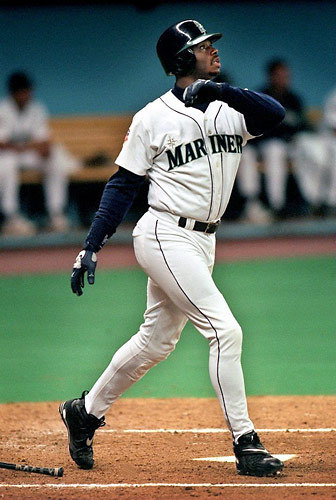
Amid the hustle and bustle of perfect games, would-be perfect games, instant replay debates, the Finals in basketball and hockey, the passing of arguably the greatest coach of the past century, and Americans preparing for the one month out of every four years in which they turn their attention to some European sport where you can't use your hands, we all had to wave goodbye to a big part of our childhoods. With considerably less fanfare than anyone would have predicted 5, 10, or 15 years ago, Ken Griffey, Jr. retired this week.

If you knew me during Griffey's days with the Mariners, you'd never have expected me to write something like this. Part of that may have to do with Junior tattooing Yankee pitching to the tune of a .311 average, 36 bombs, and 102 RBI in 501 career at-bats, akin to full season's worth. And there's also the image of him sprinting around third and sliding into home plate for the series-winning run in the 1995 ALDS that reduced me to tears as a 9-year-old. But another part of it was, despite his otherworldly talent and charisma, the guy came off as a bit of an asshole during his most productive years. He was a polarizing figure. Some saw his ever-present backwards hat as a testament to youthful exuberance, and others saw it as a "look at me" disrespect to the game. His patented bat-slam and slow walk out of the batter's box (at the :20 mark of the video) when he knew he'd just went yard was a staple of mid-'90s Sportscenter highlights, but was also the textbook example that taught me what it meant to show up an opposing pitcher. Almost everyone my age loved him, but I couldn't stand him.

Then he gets traded to Cincinnati between the 1999 and 2000 seasons, and proceeds to morph from The Kid to The Old Man. After 10 straight All-Star appearances and Gold Glove awards with Seattle, Griffey couldn't get out of his own way in the Queen City. From 2000-2008 (8 1/2 seasons with the Reds, and a forgettable second half of '08 with the White Sox), Junior played over 140 games just three times. As the numbers indicate, he was still a good player in the second half of his career when he could stay on the field, but nowhere near the perennial MVP candidate we remembered. To see him keep coming back from injury after injury was a sad yet inspirational image. Despite the severely curtailed on-field production, the mid-2000s version of Ken Griffey, Jr. was the one that skyrocketed in my estimation, and ultimately gained the same admiration out of me that my whole generation had bestowed upon him 10 years earlier.

Why, do you ask? Why did it take a late-career decline for me to finally give a nod to the greatest player of my generation? Because the decline itself, as weird as it sounds, was refreshing. It made him 100 times more likable in my book. At the very same time that Barry Bonds' production in his late 30's and early 40's was making a mockery of the game and raising every eyebrow in the nation toward the steroid issue, Griffey was experiencing the down end of the classic career bell curve. The handwriting was on the wall - Griffey was famously one of the few players of his era who eschewed lifting weights and instead went the flexibility route to generate his bat speed and power. So when the flexibility started to decrease and the body got more brittle, Junior became a shell of his former self in his last few seasons. And that's totally OK. If anything, it restored us to a time when a guy could put together a few monstrous seasons and not be immediately suspected of using PEDs.

It's funny, but these days the best thing a superstar can do for his legacy is have a few down years to close out his career. Junior simply did what guys like Aaron, Mays, and Mantle did in years past- he got old. And you know what that allows us fans to do? It lets us look back on the guy's legendary career (devoid of juiced-up late career numbers) with admiration instead of speculation. For that I'm willing to look the other way on the things I disliked him for in the '90s, and instead focus on the unbelievable catches, the shows he put on in the Home Run Derby, and that wide, captivating smile. I'll remember Junior from now on for being the best baseball player of the division-play era, and for doing so by natural talent, not by anything that came out of a syringe.